
What is a will?
No one really likes to think about what they need to do to secure their assets after their passing. But making a will is simpler than you might think.
Here we break down what a will is, what you can include, and how to make sure it is legally valid. Your will is one of the most important legal documents you’ll sign, so make sure it reflects what you want.
A will is a legal document that lays out what happens to your assets after you pass away. This can include property, investments, private pensions, and items of sentimental value. You can also outline how any dependants will be taken care of and leave provisions for them. This could include children, grandchildren, or even pets.
Your will is a list of your wishes, and you can set limitations on any inheritance. For example, you can put money in a trust until a young family member reaches 25. You can also name any charities you would like to support and state how much you want to leave.
A will does not have to be full of legal jargon. It is simply a clear record of your wishes to be carried out after your death.
What if I don’t write a will?
When someone dies without writing a will, it is called dying intestate. This means that their belongings will be shared out according to the rules of intestacy.
If you were married, not all of your assets automatically pass to your spouse in every case, as distribution depends on the size of your estate and whether you have children. If you were not married but have children, your estate may pass to them under the intestacy rules. These rules do not give you the freedom to include other people or set out your own wishes.
Writing a will, and making sure your loved ones know it exists, can make life much easier for your family later on.
Who writes a will?
You have three choices for making a will when it comes to choosing a legal professional. Solicitors and will writers offer will writing services and can help ensure your will is legally binding.
You can also decide to do it yourself by buying a will template. You simply fill it in and make sure it is signed correctly in front of independent witnesses. This is not usually recommended unless your will is very simple.
How do I choose between a solicitor and a will writer?
- Solicitors are suitable for anyone writing a will. They can deal with more complex estates, such as those involving a business, royalties, property abroad, or other complicated assets.
- Professional will writers specialise in will writing. They can guide you in creating a clear and legally binding will, but they are generally best suited to low and medium-complexity wills. They also often cost less than a solicitor.
If you own a home but the rest of your assets are straightforward, a will writer may be suitable.
If you’re still unsure, read our article on the differences between a solicitor and a will writer.
Make sure your will is valid
Ensuring your will is legally valid can help stop people contesting it. To contest a will, someone argues about how the assets are shared out. This is often done by someone who believes they should have been included in the will, or who expected to receive more.
The person contesting the will must prove that it is invalid. This could be due to a missed signature, or a more serious allegation such as fraud or undue influence.
The most important thing is to make sure your will meets the legal requirements. It should be clear that the document is a will and that it sets out your latest and final wishes.
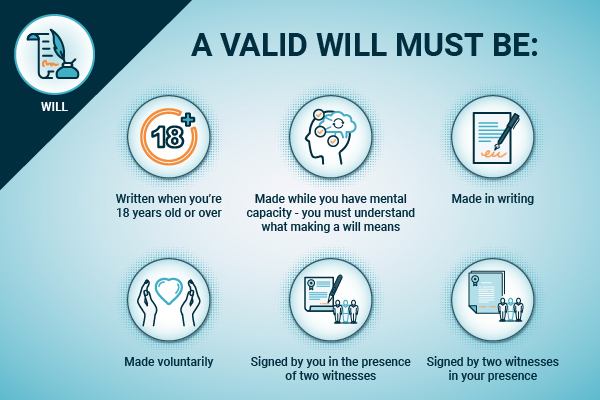
A valid will must be:
- Written when you are 18 or over
- Made while you have mental capacity and understand what making a will means
- Made in writing
- Made voluntarily
- Signed by you in the presence of two witnesses
- Signed by two witnesses in your presence
What to include in your will
Whether you sit down with a legal professional or work it out yourself, consider the following.
Start with your estate
Your estate is everything you own: your home, possessions, money, and other assets. You should have a clear idea of the full value and contents of your estate. A solicitor or will writer can advise if you have forgotten anything important.
Your debts are also part of your estate. When you pass away, these are usually paid off first. What remains is then divided among your beneficiaries.
Choose who gets what
The people who inherit from your estate are known as your beneficiaries. Be specific where necessary in your will. Do not leave everything open to interpretation, as that can leave room for confusion or a challenge.
It is entirely up to you who gets what, but it is worth considering the tax implications. You do not want your family losing out on much-needed security. This is where will writing can become more complicated, so getting legal advice is sensible even if you intend to write your own will. A solicitor should be able to advise on issues such as inheritance tax, and you may also want to speak to a financial adviser.
It is not usually like the movies. Your beneficiaries are unlikely to gather in a solicitor’s office for a formal reading of the will.
Once probate is complete and the will is accepted as valid, the executor will notify beneficiaries about their inheritance. They should be told within three months, but sooner is usually better. Beneficiaries can then respond, ask questions, or contest the will if they believe it is invalid.
Think of the children
If you have children, think about how your will provides for them when you are gone. Your will should nominate a guardian, someone to care for your children if both parents pass away.
Children cannot usually receive an inheritance until they are at least 18. You may choose to increase this age, commonly to 21 or 25.
In the meantime, your child’s inheritance can be placed in a trust overseen by a trustee of your choosing. Choose carefully and plan for financial arrangements until they come of age. Make sure you have spoken with the person you want to look after your children, and with any trustee you choose for their inheritance. These things can come as a shock if no one knows your plans.
Choose a responsible executor and witnesses
Your will must name at least one executor. This is the person who will collect your estate and distribute it according to your will. An executor can also be a beneficiary.
You may name up to four executors, and it is often best to name at least two. That way, you have a replacement if your first choice is unwilling or unable to act. Choose an executor who is responsible, organised, and fair. There is a lot of work involved, so many people choose their partner or a solicitor.
Choose your two witnesses on a similar basis: reliable, honest, and financially independent. Witnesses should not benefit from your will, as any gift to them may fail. If the will is later challenged, it is the witnesses’ job to confirm that you made the will of sound mind and of your own free choice.
Usually, all of you must be in the same room while watching each other sign and date the will. However, due to the pandemic, wills could in some circumstances be witnessed through a door or window, or by video call.
Executors and witnesses must be 18 or over and mentally capable.
What not to put in your will
There are a few assets and instructions you should not, or do not need to, include in your will.
Joint bank accounts and properties
Joint bank accounts and jointly owned property held as joint tenants usually pass automatically to the surviving owner. Your will does not normally affect this process.
Business assets
Depending on the structure of the business, you may not be able to gift business assets without the agreement of surviving business partners or in line with any shareholder or partnership agreement.
Life insurance and pensions
Your life insurance and pension should already name a beneficiary, so there is usually no need to include them in your will.
Specific conditions and wishes
Your will should contain practical instructions, but you cannot usually enforce unreasonable personal conditions, such as requiring someone to marry in order to inherit.
Your dream funeral procession
You may have detailed ideas about your funeral, but it is best not to rely on your will to communicate them. Probate can take several months, meaning your funeral may take place before your wishes are even read.
If your funeral wishes are important to you, share them directly with a loved one.
Things you don’t own
If it is not yours, you cannot leave it as a gift. It may sound obvious, but it is a common mistake.
Storing your will
You do not need to legally register a will, although services are available that offer this. You do, however, need to keep the original safe.
You can keep it at home, in a bank, or with your solicitor. You can also use a will storage company or the London Probate Service.
Tell your executor, and anyone else who may need to know, where your will is stored. They will need it to apply for a grant of probate.
Changing your will
Making a will is an important step, so you want to get it right the first time.
However, it is sometimes a good idea to update your will using a codicil. This is a note attached to the original will that records updated information. For example, you may want to include a new grandchild.
In some cases, making a new will makes more sense. Whenever you experience a major life change, such as getting married, buying a house, or having a baby, writing a new will is often the better option.
You may also want to make sure someone does not inherit from your estate. If you do not want someone to inherit, do not simply leave them out without thought. In some cases, that could lead to a challenge if they argue they were excluded by mistake. Legal advice can help you decide the best approach.
Be careful about adding too many codicils, as they can make your instructions unclear and leave your will open to challenge. If there are several changes, it may be better to write a new will from scratch.
Learn more about writing a will.